
Kayla Cindric
Digital Portfolio
11th Grade
Introduction
At the Dayton Regional STEM School, in 11th grade, it is the year to prepare for college and to tie together the many group and individual projects we complete to help us be prepared and succeed in the future. Different projects helped strenthen different weakenesses that will be beneficial in the future. As graduation comes closer, relying on the projects to help us grow has become an essential part of high school. It is an opportunity to learn different concepts and qualities in our classes. Over the course of this year, I have become more prepared for college and the future because I have grown in knowledge of several topics in each of my classes. In Technical Reading and Writing, I have grown in my understanding of how to write well-written instructions/procedures for a certain age group and write useful notes. In a polynomial project where we had to create a roller coaster using a polynomial equation in Algebra II, I grew in my understanding of what polynomials are and how to apply them to outside of the classroom. I am more confident in solving and graphing polynomial equations. While learning more about United States Government, I grew in my ability of intertwining legal documents to prove my opinions as evidence. In Chemistry, I grew in in my knowledge in how to solve problems using dimensional analysis and hydrate formulas. As I was creating a traveling website to Italy for Chinese III, I was able to further my understanding in how to create an itinerary, packing list, and traveling plan in Chinese.The sections below go into more detail about each class, projects, growth, and artifacts.
Algebra
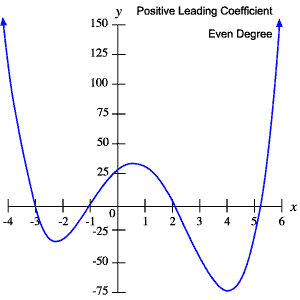
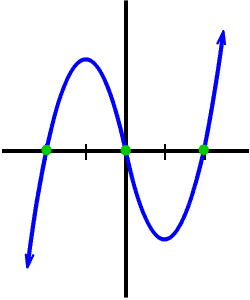
In Algebra II, I grew in my understanding of polynomials. I was able to comprehend different terms and be able to apply my notes and what I learned into the real world. In Algebra II, we learned about polynomials. We learned about what polynomials are, what they look like with different degrees, how to find equations, and how to graph the equations. During this unit, we learned that polynomials are expressions that consists of two or more functions/algebraic terms. For an example: y=0.5(x+2)(x-5)3(x+4) which is in factored and y= x4-x3-5x2+3x+6 which is in standard form. We learned that a degree is the highest number exponent in a standard form polynomial equation. So, in y= x4-x3-5x2+3x+6, the degree is four. The degree shows the different of both ends of the equation when graphed. In even number degree graphs, both ends of the graph either go up or down. In odd number degree graphs, on end of the graph goes up and the other end goes down.
Odd number degree graph:
Even number degree graph:
To further our understanding and put our knowledge of polynomials to the test, we completed the polynomial roller coaster project. The purpose of this project was to help us but what we already knew into a creative display and apply it to the real world. To accomplish this project, we needed to graph a roller coaster using a polynomial equation, it needed to include the maxima and minima, dives below the ground (x-axis), least four minutes long, lists the degree, factors, end behavior, intervals, and labels.
We first had to learn about polynomials. I used my notes to help guide me to make a successful rollercoaster and find the factors, degrees, end behaviors, etc. Without my notes, I wouldn’t be able to successfully do well on this project since I did not know anything about polynomials before this unit. Without my notes, I would not know how to find a standard form equation from the factored form. I would not be able to complete all the requirements of the project if I did not have my thorough and organized notes to look back to. That is why my notes are one of my artifacts. It shows that at the beginning I was not understanding some concepts since I would get the answers wrong, but by the end of the unit, I was getting the answers right. It shows that since my notes were thorough and informational, defining terms, step by step processes to find answers to problems, etc., I was able to use them on my polynomial project.
My second artifact is my final polynomial poster. This poster shows all the components that we have learned and put into creative display and accurate. This poster shows that I was able to put what I learned and that I used my notes to create a polynomial roller coaster. At the beginning, I did not understand anything about polynomials. In the end and with my project, I was able to understand polynomials and show that I understood with making the poster.
After taking thorough notes and creating the “polynomial roller coaster” project, I was able to grow in my knowledge of polynomials and how to effectively apply my notes to bigger and greater things.

This is my final polynomial poster where it shows that I grew in my understanding of applying Algebra concepts to the real world. Click on the picture to view it.
These are my polynomial notes where it shows that I grew in my understanding of writing thorough and clear notes on Algebra concepts. Click on the picture to view it.

This year in government, I grew in my ability of intertwining legal documents to prove my opinions as evidence. This semester of Government, we were trying to pass Senate Bill 112, also known as Matthew’s Bill, where it advocates for individuals with disabilities that are unable to access public restrooms. Previous students have been trying to create the bill and get congress to pass it. It was this year’s students that received the work load and try to convince congress to pass it as a law. In many assignments, we applied documents to situations to help us support our claims to help us develop the skills needed to create our argumentative essay. We created an argumentative essay claiming why we believe that SB112 should become a law using quotes from the Americans with Disabilities Act of 1990, United States Constitution of 1789, Declaration of Independence of 1776, and the Ohio Constitution of 1803.
This project was intended to help the juniors develop their own opinions and be able support them with legal sources to pass legislation. This helped us in the future in case we want to cast our opinions about a certain issue that we feel we need to be addressed. This helped us know how to create a successful argumentative essay. In order to be able to complete this project, we first, must have needed to learn about the bill. We learned more about this bill by listening to guest speakers such as Senator Peggy Lehner and Jennifer Helton, school intervention specialist, who is impacted by this bill. Listening to their opinions on why they support this bill and the struggle that many people face today helped us develop arguments we could include in our essay. It helped us make the choice of what we support and why. After we were informed of the bill and chose what we supported, we began writing our essays and researched the documents to enhance our writing.
During this project of writing an argumentative essay, I struggled with finding quotes from sources to help support Senate Bill 112. It was difficult to intertwine the quotes that I found with reasoning and tie it back to how it is relevant to Matthew’s Bill. I struggled with explaining how this issue affects the government and why the bill is necessary and proper. I needed to overcome this challenge, so I can write a successful essay. I was able to overcome this challenge by asking my peers how they included the documents and had peer critiques to see what I did well and what I needed to improve in. After each draft, I was able to receive feedback from my teacher which was very helpful since it was able to show me what I needed to find and include in my essay.
During this semester of government, I learned what makes a bill necessary and proper which means that it the bill or idea is needed in society. In order to complete this project, we learned about the Amendments, which helped magnify my essay in supporting my opinion. I was able to use the 14th Amendment which says that states cannot deny any person within its jurisdiction the equal protection of the laws. I was able to justify how this relates to Senate Bill 112 by stating that individuals with disabilities have been stripped of their equal rights and protection to use public restrooms since the accommodations are not available for them. I researched the Americans with Disabilities Act which I found explained that individuals with a disability should be excluded from participation in or be denied the benefits of services, programs, or activities of a public entity. I backed this quote up by saying that using a public restroom is a public activity; it is a service that females and males get in society. Having no access to a restroom available for individuals with disabilities is discrimination and should not be permitted. I continued to support my opinion by quoting the Ohio Constitution by explicating, “All men are, by nature, free and independent, and have certain inalienable rights, among which are those of enjoying and defending life and liberty, acquiring, possessing, and protecting property, and seeking and obtaining happiness and safety.” I elaborated more by stating that this quote assures that individuals with disabilities should not be excluded from society because their rights are not given to them. They are citizens and should not feel alienated because their needs are not met by society.
SB112 will help assure that all citizens will have equal rights to where they can use the restroom. We learned that in every argumentative essay, there needs to not only be a thesis statement that states you claim, evidence, and reason, there also needs to be a counterargument which helped the argument by showing that that the opponent’s view has been considered and a solution has been made and it won’t affect the passing of the bill.
My first artifact is the first draft of my argumentative essay which shows that I did not know how to incorporate the legal documents to my claim and how to back it up with relevant reasoning. It also shows that I did not know how to paraphrase quotes and further explain it. When I talked about how the United States Constitution supports Senate Bill 112, I included a long quote which half it made no sense and there was no reasoning behind how the quote helps support the bill. I also did not have a counterargument or a closing sentence in my first draft. I thought it was a really well-done draft and could pass as my final draft, but when I finished my final draft, I saw that it was so much better.
My second artifact is the final draft of my argumentative essay which is different than my first draft and definitely shows improvement. I included what I knew about the bill, why I think Senate Bill 112 is necessary and proper, backed up my thesis with evidence from all four sources and more, explained the quotes with relevant facts and information, and included a counterargument which provided more evidence and support to my claim. Before this project, I would not have been able to know how to incorporate documents decades to centuries back to support a bill today. This project helped me realize what I needed to include to make a successful essay stating my opinions. It helped me learn to paraphrase and how I can tie my evidence to my claim with reasoning.
To the side of my reflection are my artifacts.
This my first draft of my argumentative essay where it shows that I did not how to intertwine legal documents to an argument.
Click on the icon to view the draft
This my final draft of my argumentative essay where it shows growth in applying legal documents to strenthen my argument.
Click on the icon to view the essay.
Government
Technical Reading and Writing
During Technical Writing and Chemistry, we completed a project to help us learn how to write up and create a usability test for sixth graders (which included making well-written instructions that have terms that the sixth graders will understand, and how to revise our content based on their level of knowledge.) The goal of this learning experiment (for the 11th graders) was to understand what a usability test is, why they are necessary in creating instructions for any experiment/product, how to create thorough and correct instructions that meet the tester’s/audience’s knowledge level, and write effective and clear notes.
In Technical Reading and Writing, I grew in my understanding of how to write well written instructions/procedures for a certain age group and record data. Furthering my knowledge, prepares me for the future because I know now what makes well-written instructions and procedures that would match different age levels. In Dentistry, a career that I want to pursue in you need to write clear notes, create instructions to create molds and perform cleaning, and how posters that will help show children what will happen while they are getting their teeth cleaned.
In order to complete this experiment between the two classes and grow, many steps were taken. First, we had to know what was needed in instructions/procedures for the experiment. Instructions have to be written with simple and clear procedures. Each step, must be short, begin with an action verb, and be numbered. We put our knowledge in action and created the procedures, materials, purpose, diagrams, warnings and cautions, and tables.
We were ready to conduct a usability test which we learned what they are and what they are used for in class. In class, we learned that a usability test is a test to see what the testers are struggling with or understanding when reading/completing a set of instructions, so that we can revise them and make them better based on the struggling points. Conducting usability test helped what we needed to change so that the terminology would match what they already knew. Second, we learned what experiment we were doing. The experiment involved pouring baking soda and vinegar together in a flask (that was hooked up to another flask) to observe the results of the chemical reaction in another tube. Sixth graders were our testers.
Next, we created a preliminary survey for the sixth graders to complete. This survey helped us, juniors, see where the sixth graders’ knowledge level was at and what we needed to change in our procedures to assure that they would understand the terms. After we saw that the sixth graders struggled with understanding: what the abbreviation for grams and milliliters were, were what chemical reactions were, what stoppers were, etc. we changed our procedures. Instead of writing in our instructions “g” and “mL” for grams and milliliters, we wrote out “grams” and “milliliters”. Also, instead of writing “stopper”, we wrote “black plug” which is the same thing. This helped them know that it was use to plug and cover the flask. We also explained what a chemical reaction in the poster so that they could understand what is happening in the experiment.
We learned about Concurrent and Retrospective. These “tests” are used during the usability test to record the tester’s reactions, what they struggled with, why the struggled with it, what they learned/recall, what they did right and wrong, etc. to help us further improve our procedures even more. We created a survey (retrospective) using questions to see what they recall, learn, struggled with (after the test) and also wrote notes while they were completing the test. After we collected their feedback and saw what we needed to improve based on what they struggled to comprehend, we revised our instructions one more to time to fit their knowledge level, so the next we do another usability testing round, the testers will understand what they need to do.
My first artifact is our procedure poster. During this portion of the project, I was able to learn how to create clear instructions that were short, numbered, and began with an action verb. I also learned how to write the correct way of writing a WARNING and a Caution and the difference between them. Learning to write clear instruction will help me prepare for college because I will be taking a science class whether its chemistry or biology, and I will need to be able to create clear instructions that the target audience will be able to understand and correctly follow. In the beginning, I started out each step without an action verb (such as “pour” or “record”, used long sentences, and put it in paragraph form. In my final draft of my poster, it shows that I have the instructions in a list, start with an action verb, and have short sentences. This artifact shows that I have grown in Technical Writing because without this practice and project, I would not have been able to know how to create well-written instructions and I would not have known what a usability test was. To be honest, I would have skip the usability test because I wouldn’t have known the importance of it and that would not be good, because I would not have known what to revise to make it better to follow. Also, making a poster was a great way to portray information for children to know and understand what will be happening during their cleaning because there will be visuals.
My second artifact is our professional document where we took what we observed during the usability test and summarized it, what we changed, and why based on our feedback. Documenting and summarizing the test helped me know what I could/would do differently next time. It shows that I have grown because I would add where you specifically get the materials (such as water from the sink) because they were not aware of their surroundings and where things are in a new environment. It helped me know what to fix and include based on what the testers needed help with. We created this by looking back through our notes and seeing what was needed to revise and change, what they struggled, what they were doing that we not part of the instructions and why, etc. They struggled with understanding repeated steps (when it said “repeat steps 1-3 with different amounts of water. We wrote in our notes what made them struggle and why. We, then, changed the wording so that they understood and included examples in our instructions. Learning to take well written notes will help me in the future because it was a great effective note taking practice for me to be able to take notes and use them again to help us write up a “reflection” of what occurred during a usability test (or in dentistry: what the issues are with their teeth) and how to create a professional document if I were to create one in the future.
This project has benefited me for the future and college because I was able to create simple, short, and clear instructions and a way to display the information and data which I could potentially use in the future.
Chemistry

This is my first artifact for Chemistry. Clink on the icon above to see the document.


These are pictures of my experiental poster that sixth graders followed to set up the experiment we created.
These are notes that I took to help me write thorough notes to help me improve my work.


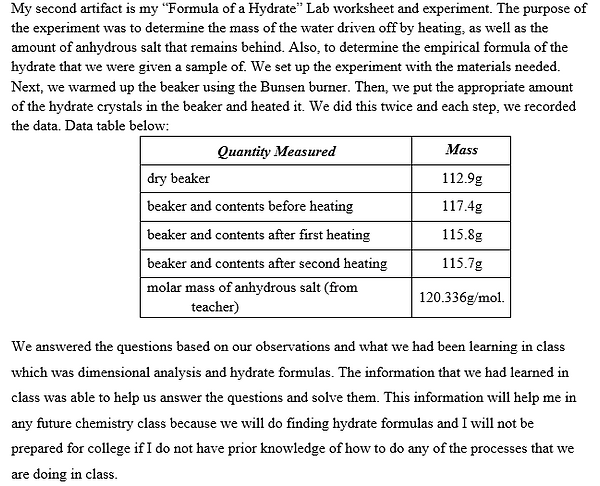


This is my first artifact for Chemistry. Clink on the icon above to see the document.


Chinese
During this year in Chinese III, I grew in my knowledge of how to ask someone what their holiday plans are, what places they are going to on a trip, ask how long the trip will be, traveling and packing vocabulary, how to create a packing list, a summer plan, and create an itinerary in Chinese.
During this unit, we integrated Economics and Chinese III together to create a traveling website for a teacher. In Chinese III, we translated the itinerary, summer vacation plan, and packing list in Chinese. My group created a plan for the 11th grade Algebra II teacher to go to Italy for herself, her two sons, and husband. Before this unit, I did not know most of the vocabulary words such as 行程 which means itinerary or 护照which means passport, along with other characters. Not only did I not know several of the characters, I did not know the sentence structures. Chinese and English may be similar in some ways, but in sentence structures, they are different. In Chinese sentence order is subject, time, location, verb, and object (STLVO). We also learned that to say “already” or you already did it something, you add 好了 at the end. For example, if you want to say “I already got your VISA” you would say “我签证已经办好了。”我 means I. 签证 means VISA. 已经 means already and 办好了means already got. So if you translated the Chinese sentences right into English, it would say “I VISA already got”. I learned so much during this unit that will help me if I ever travel to China.
My first artifact is my Economics and Chinese traveling website. The website shows that I grew because I was able to translate the sentences correctly. At first, I was having trouble writing the sentence correctly. I would forget to put 要 (means going to) and 去 (to go) in sentences. I fixed this sentences on my website so that they were correct. This artifact has my itinerary, packing list, and summer plan in Chinese.
My second artifact is my skit video and script. Not only did I learn to write and type the characters, but enhance my speaking skills. I was able to practice and put my knowledge that I learned in this unit to the test with writing and speaking everything that we put in our website. In the skit, we included the packing list, vacation plan, and itinerary. Before this unit, I did not understand the sentences let alone know how to speak them. By the end of this project, I was able to write up a script and speak it. I included sentences that I learned such as that I already packed my luggage, from (this date) to (this date), and how to say what I am planning to do over the summer. (我的行李准备好了,从(this date) 到 (this date) ,我要参加学校的中国 旅行。
Without this project, I would not have been prepared for the future to go to any foreign country especially China. I was able to learn how to translate many components for a trip.

This is my Chinese and Economics traveling website where it shows my growth and knowledge in how to translate an itinerary, packing list, and vacation plans in Chinese. Click on the picture to view of the website in your browser.
This is my Chinese traveling skit where it shows my growth and knowledge in how to speak and converse in Chinese. Click on the video to view of it in your browser.
Conclusion
Over the course of the year, I had learned and expanded my knowledge in several different topics to help me prepare and be successful in college. Junior year was challenging due to fast-approaching deadlines where I had to manage my time, and projects that made me collaborate with my peers. These challenges might have made my junior year difficult, but they strengthened my weaknesses. I had several successful moments that I will remember to help me and have several moments of failure to learn from to improve upon in the future.